11 — Simple instruments
Theme: instruments that report a handful of values rather than a size distribution.
A dosimeter, a gas monitor and a photometer all produce one or a few channels over time. They reuse the whole Aerosol1D machinery — activities, time operations, statistics, plotting — and add accessors named after what they actually measure.
Instruments that do not count particles (gas monitors, environmental loggers, the Partector) deliberately have no total_concentration: reporting a chlorine reading as a particle number concentration would be wrong. Use their own accessors instead.
[1]:
import aerosoltools as at
/opt/hostedtoolcache/Python/3.11.15/x64/lib/python3.11/site-packages/tqdm/auto.py:21: TqdmWarning: IProgress not found. Please update jupyter and ipywidgets. See https://ipywidgets.readthedocs.io/en/stable/user_install.html
  from .autonotebook import tqdm as notebook_tqdm
Partector — lung-deposited surface area
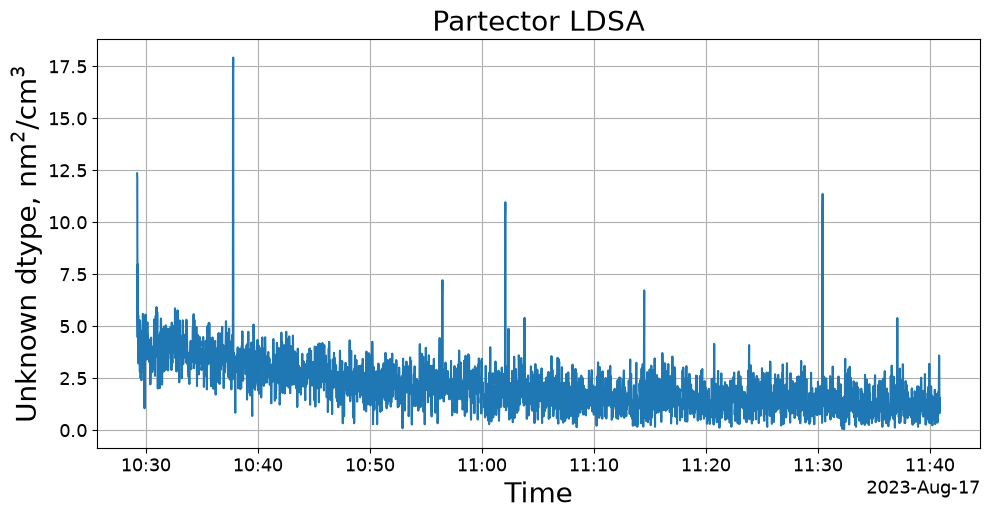
The Partector reports LDSA, the surface area of particles that deposits in the lung. The TEM variant also samples particles onto grids for microscopy, and records when it did so.
[2]:
partector = at.load_partector_file("../../tests/data/Sample_Partector.txt")

print("instrument:", partector.instrument)
print("columns   :", list(partector.data))
print("unit      :", partector.unit)
⚠️ Warning: More than one TEM sampling period detected in ../../tests/data/Sample_Partector.txt
instrument: Partector
columns   : ['LDSA', 'TEM', 'Flow', 'All data', 'TEM grid sampling 1', 'TEM grid sampling 2']
unit      : {'LDSA': 'nm$^{2}$/cm$^{3}$', 'TEM': 'bool', 'Flow': 'l/min'}
[3]:
print("LDSA :", partector.ldsa.head(3).tolist(), partector.unit)
print("flow :", partector.flow.head(3).tolist())
LDSA : [12.35, 12.1, 5.59] {'LDSA': 'nm$^{2}$/cm$^{3}$', 'TEM': 'bool', 'Flow': 'l/min'}
flow : [0.69, 0.6, 0.52]
tem_samples reports the grid-sampling periods, so microscopy results can be tied back to the time series they came from.
[4]:
partector.tem_samples
[4]:
| Start | End | Sample_vol [ml] | |
|---|---|---|---|
| 0 | 2023-08-17 10:31:44 | 2023-08-17 11:40:48 | 30546.409142 |
[5]:
fig, ax = partector.plot_total_conc()
ax.set_title("Partector LDSA")
[5]:
Text(0.5, 1.0, 'Partector LDSA')
DiSCmini — number, size and LDSA
The DiSCmini reports a particle number concentration, a mean particle size and LDSA from the same measurement. It does count particles, so it keeps total_concentration.
[6]:
disc = at.load_discmini_file("../../tests/data/Sample_Discmini.txt")

print("columns:", list(disc.data))
print(f"number : {disc.total_concentration.mean():.0f} {disc.unit}")
print(f"size   : {disc.size.mean():.1f} nm")
print(f"LDSA   : {disc.ldsa.mean():.1f}")
columns: ['Total_conc', 'Size', 'LDSA', 'All data']
number : 19750 {'Total_conc': 'cm⁻³', 'Size': 'nm', 'LDSA': 'nm²/cm³'}
size   : 30.9 nm
LDSA   : 25.8
Mean size is a single number, not a distribution — the DiSCmini cannot distinguish a narrow distribution from a wide one with the same mean. For that you need a sizing instrument, see 8 — PSD fitting.
DustTrak — PM mass fractions
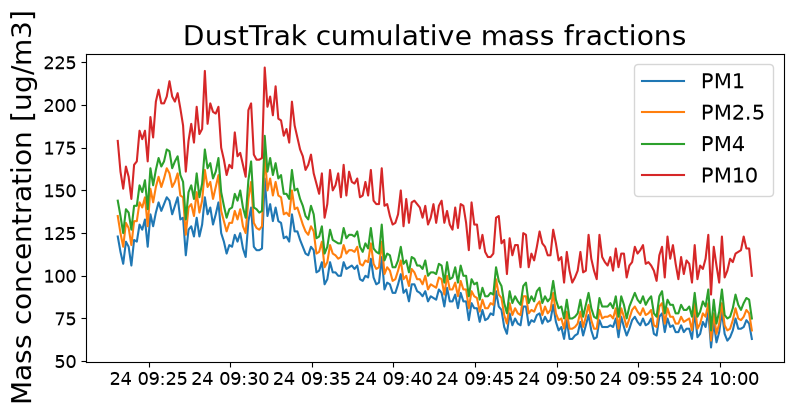
The DustTrak DRX reports the standard mass fractions simultaneously.
[7]:
dust = at.load_dusttrak_file("../../tests/data/Sample_DustTrak.csv")

print("instrument   :", dust.instrument)
print("serial number:", dust.serial_number)
print("columns      :", list(dust.data))
print("units        :", dust.column_units)
instrument   : DustTrak DRX
serial number: 8533151303
columns      : ['PM1', 'PM2.5', 'PM4', 'PM10', 'Total', 'All data']
units        : {}
[8]:
print(f"PM1   {dust.pm1.mean():7.1f}")
print(f"PM2.5 {dust.pm2_5.mean():7.1f}")
print(f"PM4   {dust.pm4.mean():7.1f}")
print(f"PM10  {dust.pm10.mean():7.1f}")
print(f"Total {dust.total.mean():7.1f}   (all in ug/m3)")
PM1      94.7
PM2.5   103.5
PM4     111.8
PM10    141.6
Total   201.2   (all in ug/m3)
The fractions are cumulative, so each is at least as large as the one below it. The gaps between them describe the coarseness of the aerosol.
[9]:
import matplotlib.pyplot as plt

fig, ax = plt.subplots(figsize=(9, 4))
for name in ["pm1", "pm2_5", "pm4", "pm10"]:
    ax.plot(dust.time, getattr(dust, name), label=name.upper().replace("_", "."))
ax.set_ylabel("Mass concentration [ug/m3]")
ax.legend()
ax.set_title("DustTrak cumulative mass fractions")
[9]:
Text(0.5, 1.0, 'DustTrak cumulative mass fractions')
Gas monitors
Gas1D covers instruments measuring one gas at a time. The reading is always .concentration; which gas it is lives in .dtype. That split means the same code works whatever the instrument is configured for.
A Ranger uses interchangeable heads, so one file can contain several components — the loader returns one object per component.
[10]:
loaded = at.load_ranger_file("../../tests/data/Ranger_2605-1000088-A_20260612-0603.csv")
objects = loaded if isinstance(loaded, list) else [loaded]

for obj in objects:
    dtype = obj.dtype if not isinstance(obj.dtype, dict) else "PM channels"
    print(f"{type(obj).__name__:12s} {str(dtype):14s} {len(obj.data):5d} samples")
Aerosol1D    PM channels       21 samples
Gas1D        Cl₂             1578 samples
Gas1D        NO₂             1409 samples
[11]:
chlorine = next(o for o in objects if o.dtype == "Cl₂")

print(f"gas   : {chlorine.dtype}")
print(f"unit  : {chlorine.unit}")
print(f"mean  : {chlorine.concentration.mean():.4f} {chlorine.unit}")
gas   : Cl₂
unit  : ppm
mean  : 0.2685 ppm
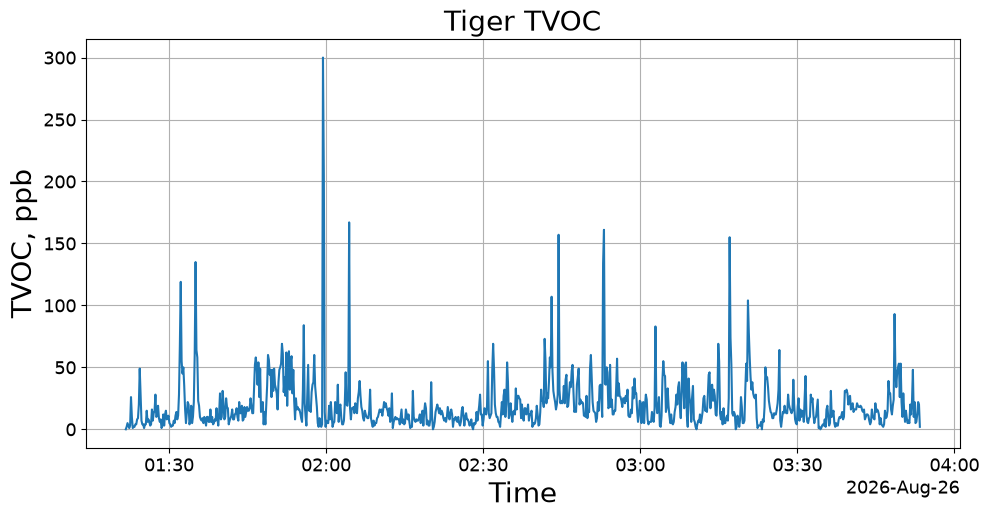
A Tiger VOC monitor is the same class with a different gas, so the same accessor works unchanged.
[12]:
tiger = at.load_tiger_file("../../tests/data/Sample_Tiger.csv")

print(f"gas   : {tiger.dtype}")
print(f"unit  : {tiger.unit}")
print(f"mean  : {tiger.concentration.mean():.1f} {tiger.unit}")
gas   : TVOC
unit  : ppb
mean  : 19.9 ppb
[13]:
fig, ax = tiger.plot_total_conc()
ax.set_title(f"Tiger {tiger.dtype}")
[13]:
Text(0.5, 1.0, 'Tiger TVOC')
Environmental loggers
Environmental1D covers temperature, humidity and related channels. Only the channels actually present in the file are available.
[14]:
env = at.load_fourtec_file("../../tests/data/Sample_Fourtec.xlsx")

print("columns:", list(env.data))
print(f"temperature: {env.temperature.mean():.2f} degC")
print(f"RH         : {env.rh.mean():.1f} %")
columns: ['Temperature', 'RH', 'All data']
temperature: 22.70 degC
RH         : 46.6 %
Asking for a channel the file does not contain raises a message naming what is available, rather than a bare KeyError.
[15]:
try:
    env.pressure
except AttributeError as err:
    print("AttributeError:", err)
AttributeError: Environmental1D has no 'Pressure' channel in this file; available channels: Temperature, RH, All data.